
Train GMDSS operators on real procedures, without buying a single console
Vox Maris puts a complete GMDSS radio room on ordinary PCs. Your students transmit and receive on more than 25 simulated communication and navigation devices, make the decisions a real distress situation demands, and get it wrong where getting it wrong costs nothing. Your institution buys software, not hardware.
It is designed to comply with the regulations and recommendations of the International Maritime Organization (IMO), the International Telecommunication Union (ITU), the STCW Convention and SOLAS, and it holds a DNV Statement of Compliance as a Class A (COM) radio communication simulator under DNV-ST-0033 of August 2023, covering the STCW competences of tables A-IV/2.1 and A-IV/2.2 and valid until February 2030 — you can verify it yourself at trust.dnv.com. It is also certified by the Association of Marine Electronic and Radio Colleges (AMERC, UK) and approved by prestigious maritime authorities: the General Directorate of Merchant Marine of Spain, the Argentine Navy, DIRECTEMAR of Chile, the Polish Navy and the maritime authorities of Indonesia and Panama, among others.
More than 150 universities, academies and maritime training centres already teach with it.

One simulator covers your whole radio syllabus — GOC, ROC, LRC and SRC, plus skipper and recreational training — across the equipment of SOLAS sea areas A1 to A4, including Iridium GMDSS and Inmarsat FleetBroadband, the newest satellite services in the system.
No consoles. No proprietary panels. No waiting for spare parts.
This is where Vox Maris parts company with every traditional simulator. It runs on general-purpose computers over an ordinary Windows network, and a standard sound card with a headset is all the audio hardware you need.
What that means for your institution: a far lower initial investment, an installation your own IT staff can maintain, and no classroom sitting idle while a proprietary part ships in from another continent. A repair or a reinstallation does not require a specialist.
Pay for it the way that suits your budget
- Annual subscription. Support and updates included at no additional cost, payable annually or monthly. The lowest way in, with no capital purchase to approve.
- Full licence. Buy it once and use it for life, with support and updates available on request.
Either way, you never buy the simulator twice. As the GMDSS and its regulations evolve, upgrades reach you as part of the support and maintenance service.


International Certifications
Approvals issued by Maritime Authority of Spain
Directorate General of Merchant Marine
Approvals issued by maritime training centres of the Argentinean Navy
Approvals issued by maritime training centre of Polish Navy
Vox Maris in use

Simulated equipment
A student trained on Vox Maris does not have to relearn the equipment when they step onto a bridge. Every device is operated as the real one: the layout of the keys, the display and the audible behaviour emulate equipment currently installed on board.
Terrestrial communications
- VHF with DSC, Class A. All channels of the maritime mobile band according to Appendix 18 (ITU Radio Regulations), dual watch, scan and priority scan, automatic power reduction on the channels adjacent to 16 and 70, and International, USA or Canada channel selection.
- MF/HF with DSC, Class A. All radiotelephony frequencies according to Appendix 17 (ITU Radio Regulations), J3E and H3E modes, RF gain and clarity control, permanent watch on the DSC distress, urgency and safety frequencies, and direct 2182 kHz selection.
- Portable VHF. 1 W and 2 W transmit power.
- VHF air band. 121.5 MHz and 123.1 MHz, for joint SAR operations with aircraft.
- NAVTEX. Two receivers, 518 kHz and 490 kHz, with station (B1) and message type (B2) reception programming, on-screen display and printing.
- 2182 kHz watch receiver. Automatic activation on detection of the two-tone alarm signal.
- Radiotelex. ARQ, FEC, selective FEC, enhanced ARQ and coast station call, programmed with all ITU telex channels.
- Radar. X band, 0.125 to 24 nm, displaying SART signals as 12 dots, 12 arcs or 12 circles according to range.
- AIS. Graphic and list views, silent mode, ID-only filter, and channel, power and region settings.
- Radio direction finder.
Satellite communications
- Iridium GMDSS.
- Inmarsat FleetBroadband.
- Inmarsat-C. Store-and-forward data and telex messaging, enhanced group call, SafetyNET, reception of maritime safety information, preformatted distress messages to an RCC, LES list and special access codes.
- Inmarsat Fleet 77. Telephony handset, automatic distress switch on the cradle, distress alert cancellation, distress test and communication log.
- Inmarsat-B, Class 1. Telephony and telex, automatic and manual, including distress communications.
Distress beacons
- EPIRB. 406.0 to 406.1 MHz COSPAS-SARSAT band, test function, and external view of the battery expiry date, the float-free enclosure and the vessel name, flag, MMSI and beacon identification.
- PLB. Transmission on 406 MHz and 121.5 MHz.
- SART. 9.2 to 9.5 GHz, detected by the simulator X-band radar and displayed for search and rescue exercises.
- AIS-SART and AIS-PLB. With internal GPS and satellite link simulation.
Ship systems
- GPS, integrated with every simulated device on board.
- SSAS. Piracy and terrorism alert, cancellation and system test.
- Alarm panel. Distress buttons, alert reception alarms and failure indication for VHF, MF/HF and Inmarsat-C.
- Battery panel. Main generator, two battery groups and two chargers, with the real power consumption of each device discharging the batteries, the charging process, and the typical faults: AC supply failure, low voltage and high voltage.
- Navigational controls.
The instructor position
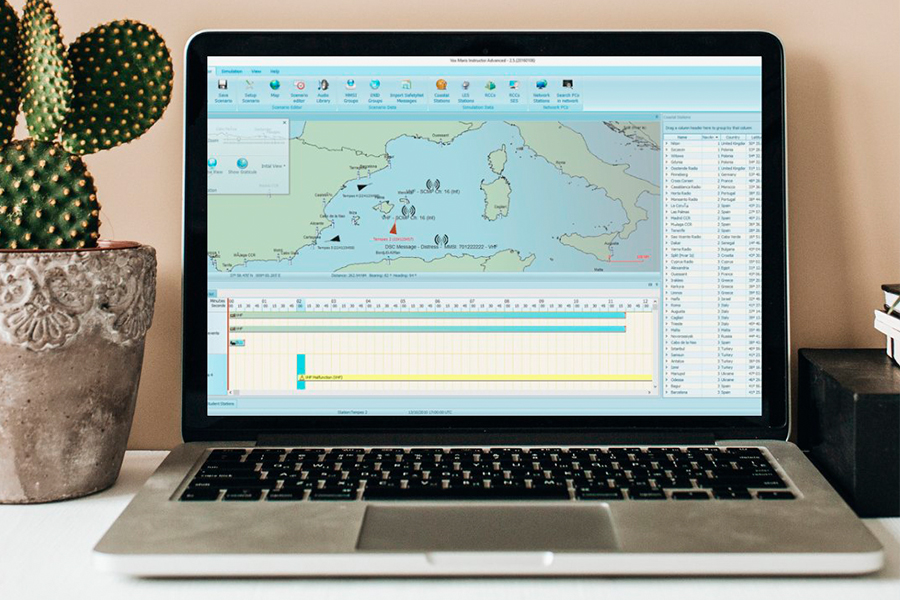
An exercise is only as good as the instructor running it. Vox Maris has two modules, Instructor and Student, and from a single position the instructor builds the exercise, runs it, listens in, takes over a station if needed and assesses every trainee afterwards on the recording.
Scenario editor
A graphical editor on a world map, with zoom, drag and drop and day or night views, where the instructor places vessels, coast stations, AIS targets and propagation regions. Scenarios are saved and reused. It includes a worldwide database of coast stations, LESs and RCCs, which can be edited to add or modify stations, their position and their equipment.
Events and faults
The instructor injects events — distress, urgency or safety situations — and faults on the VHF, MF/HF, Inmarsat, SART, EPIRB, GPS or power supply. Combining the two produces situations of any complexity: an explosion on board while the radio equipment has just been damaged, for instance, to see how the trainee reacts. Pre-recorded audio can be broadcast from any position on the map and on any frequency, on the marine or aeronautical VHF bands and on MF and HF.
Realistic propagation
Given the position of two ships, the date and the time, the simulator calculates the maximum and minimum usable frequencies. A trainee who chooses a frequency that would not work at that hour does not get through. VHF is limited to line of sight and MF to ground-wave propagation. Band-pass filters, noise, attenuation with distance, wattage limits and instructor-defined geographical regions that improve or degrade propagation all apply. The whole model can be switched off when the exercise needs to be simpler.
Coast station and RCC role
During the exercise the instructor answers as a coast telex and telephone subscriber, a coast radio station and an RCC operator, attending calls and alerts of every priority from all trainee positions at the same time. Inmarsat communications addressed to any RCC in the world — whether a distress alert routed automatically through a LES or a call to a specific centre — reach the instructor and are answered as such. Maritime safety information can be issued live over NAVTEX, telex and SafetyNET, and the instructor can also act as another ship station.
Monitoring
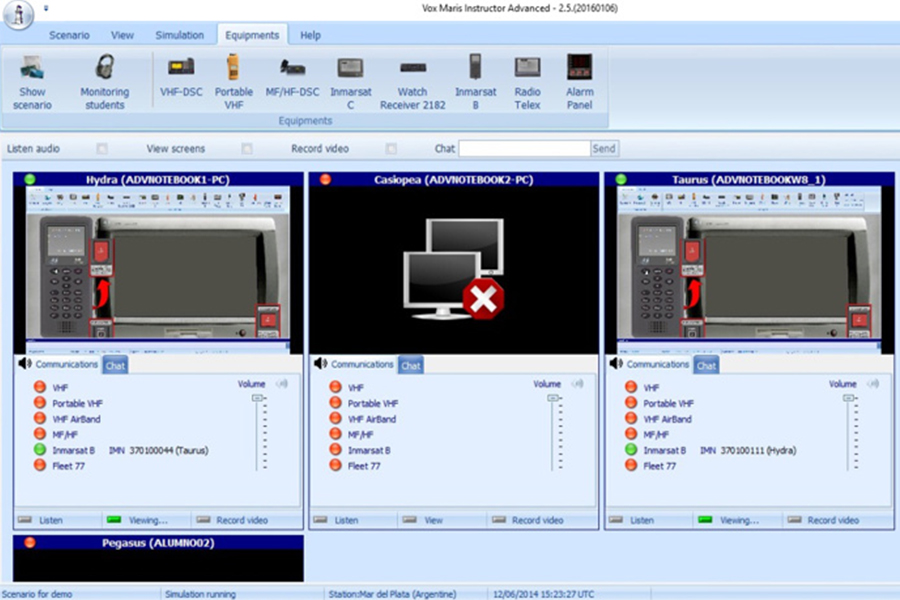
The instructor sees each trainee station in real time: heading, speed, position and the status of every device. They can listen to the ether on any frequency the trainees are using and interfere in their traffic, view the students’ screens, take remote control of a workstation and open a chat with any of them. The action log is displayed in a grid that can be grouped, sorted, filtered and exported to Excel or printed.
Debriefing and assessment
Every run is recorded in full — radiotelephone and intercom audio, and video of the procedures carried out at each position. A timeline lets the assessor move the replay to any moment, evaluate what happened there and, if useful, let the trainee start again from that point. Each ship is shown on the map with its track. The debriefing module scores performance against the audit log and the scheduled events, and produces a printable overall assessment.
Courses, versions and requirements
Certificates covered
Vox Maris provides full GMDSS training for the GOC, ROC, LRC and SRC certificates, and also covers skipper and recreational nautical training. It meets the requirements of SOLAS, the ITU Radio Regulations and the STCW Convention, and complies with IMO Resolution A.703 on the training of radio personnel in the GMDSS and with the STCW Code, sections A-I/12 and B-I/12 item 41, on performance standards for simulators used in training and on GMDSS communication simulation.
Two versions are available. The Standard version covers the devices required for the Restricted Operator’s Certificate course. The Advanced version includes every simulated device and covers the General Operator’s Certificate course.
Standards the simulation follows
The propagation and DSC models implement ITU-R Recommendations P.368-8 on ground-wave propagation, P.1240 on basic and operational MUF prediction, P.372-8 on radio noise, M.493-11 on the digital selective-calling system and M.541-9 on DSC operational procedures.
Configuration
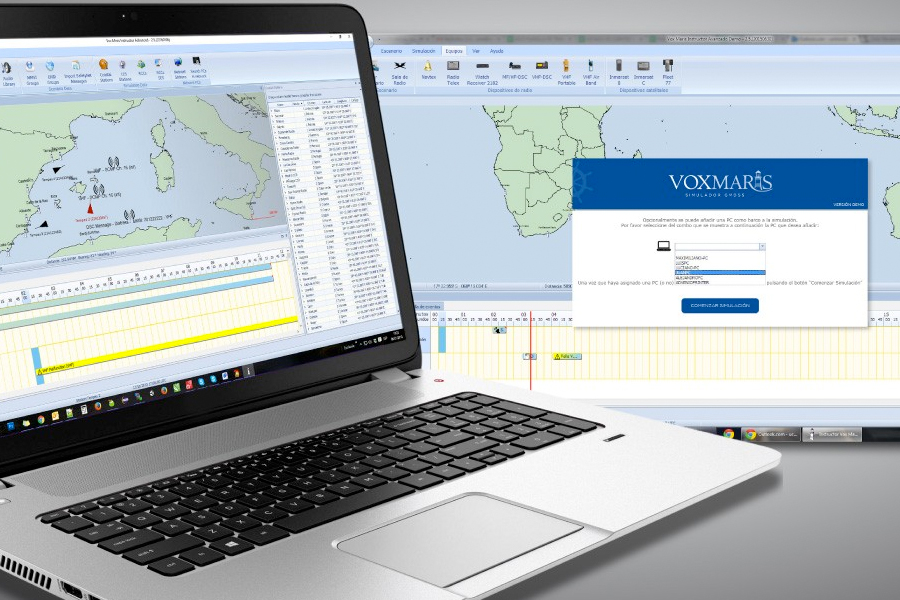
One instructor position and as many trainee positions as the classroom needs, all operating simultaneously in real time. Further trainee positions can be added to an existing installation at any time.
Requirements
- Operating system: Windows 11 or Windows 10
- Processor: Intel Core i5 or higher, or AMD equivalent
- Memory: 4 GB minimum, 8 GB recommended
- Network: Windows TCP/IP LAN, 100/1000 Mbps adapter and a gigabit switch with enough ports
- Audio: standard sound card and a headset with microphone. No dedicated audio simulation hardware.
- Displays: 1280 x 800 or higher for trainee positions, 1440 x 900 or higher for the instructor
Interface languages: English, Spanish, French and Portuguese.
Frequently asked questions
Does it need special hardware?
No. Vox Maris runs on general-purpose PCs over an ordinary Windows local network. There are no consoles, no physical panels and no dedicated audio equipment: a standard sound card and a headset are enough. This is what makes it cheaper to buy, quicker to install and maintainable by the institution’s own IT staff.
How many trainee positions does it support?
As many as the classroom requires, all running simultaneously in real time, and more positions can be added to an existing installation later.
Are updates included?
With the annual subscription, support and updates are included at no additional cost. With the full licence they are available on request. In both cases the simulator follows the technological and regulatory evolution of the GMDSS without having to repurchase a new version.
Which certificates can be taught with it?
GOC, ROC, LRC and SRC, plus skipper and recreational nautical training. The Advanced version covers the General Operator’s Certificate course; the Standard version covers the Restricted Operator’s Certificate course.
Is it certified?
Yes. DNV has issued a Statement of Compliance certifying Vox Maris as a Class A (COM) radio communication simulator under DNV-ST-0033 of August 2023, covering the STCW competences of tables A-IV/2.1 and A-IV/2.2. It was issued in February 2025, is valid until February 2030 and can be verified independently at trust.dnv.com. Vox Maris is also certified by AMERC (UK) and approved by the maritime authorities of Spain, Argentina, Chile, Poland, Indonesia and Panama, among others.
Does it simulate satellite services other than Inmarsat?
Yes. Besides Inmarsat-C, Inmarsat-B and Fleet 77, it simulates Inmarsat FleetBroadband and Iridium GMDSS.
See it for yourself
The fastest way to judge a simulator is to use one. Download the Vox Maris demo, put it in front of an instructor, and watch how it handles a full distress sequence.