
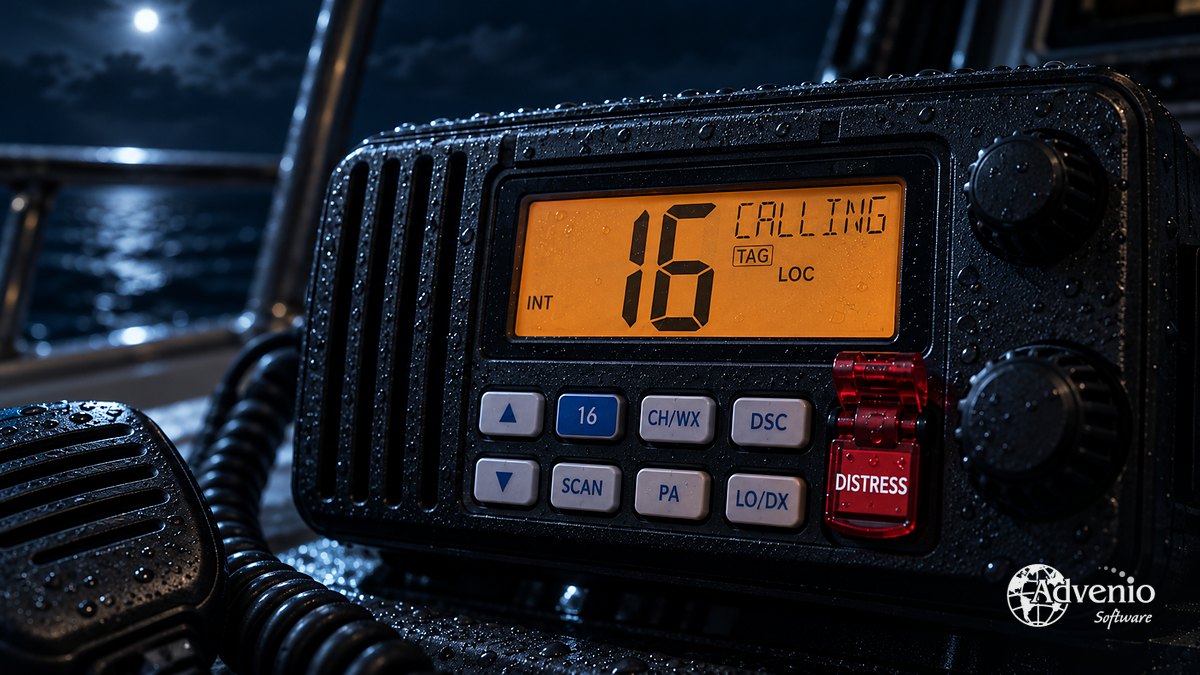
The red button on a VHF is explained in thirty seconds: lift the cover, hold it down, the alert goes out. Most courses stop there.
But pressing it is not the distress procedure. It is the first step. The set transmits the digital alert, switches itself to channel 16 and waits. And that is where the question that actually matters appears: what do you say, and in what order?
What the radio does on its own
While the button is held down, the VHF builds and transmits a distress call by Digital Selective Calling: a short data message that goes out on channel 70 — reserved exclusively for this — to every station within range, coast stations and vessels alike.
That message carries the set’s MMSI, the position handed to it by the GPS, and the time. If there was time to select it from the menu, it also carries the nature of distress: fire, flooding, man overboard, abandoning.
Once the alert is away, the radio switches itself to channel 16 and stays there. The digital alert also repeats automatically about every four minutes until someone acknowledges it or it is stopped by hand.
It is worth waiting fifteen seconds or so before speaking. That is the window in which a coast station’s digital acknowledgement may come in. If it does, someone is already listening and the voice message is addressed to them.
What goes out first
The first thing is not what is happening. The first thing is who is speaking.
That feels counter-intuitive when the urgent thing is the water coming in, but the message is built that way for a reason that becomes clear in the next section. The full script is this:
MAYDAY, MAYDAY, MAYDAY
THIS IS (vessel name, three times)
Call sign (…), MMSI (nine digits)
MAYDAY, (vessel name, call sign, MMSI)
Position (latitude and longitude, or bearing and distance from a known point)
I am (nature of the distress: sinking, fire on board, man overboard…)
I require immediate assistance
(number) persons on board
(any other useful information: liferaft on board, hull type and colour, EPIRB activated, abandoning)
OVER
Then release the transmit key and listen. If there is no answer within about two minutes, the whole message is repeated.
Why that order
The order is not a formality or a piece of radio etiquette. It is an order of message survival.
A distress transmission can be cut off at any moment: the boat heels and the antenna is lost, water reaches the electronics, the battery dies, someone has to drop the microphone to do something else. What has already been said is what remains. What was still to come is lost.
So the data is arranged from most to least useful to whoever has to go out and look:
Identification first, because it ties the voice message to the digital alert that has just arrived. On the coast station’s screen there is a new line with an MMSI and a position; the operator needs to know within the first few seconds that the voice coming in on 16 is that same vessel. From there on, everything else accumulates on the same case.
Then the position, because it determines who goes out, from where, and how soon. It already travelled in the digital alert, but it is repeated by voice: the alert may have gone out without a position if the GPS was not connected, and there may be vessels nearby keeping watch on 16 that never received the DSC call.
Then the nature of the distress and the assistance required, because they define the response: a tow is not a helicopter.
Then persons on board, which is what sizes the operation and the one most often missing.
A message cut in half that has already given who and where is useful. A message cut in half that was working through the story of the breakdown is not.
The most common mistake
In a simulation exercise the mistake is almost never forgetting a word of the script. It is starting at the end.
The cadet presses the button, switches to 16 and starts narrating: “we’ve lost the rudder, we’re taking water through the starboard bearer, we tried to pump but…”. Thirty seconds of narrative before the vessel’s name, and the position last, once they remember.
It is the natural thing to do — it is what anyone calling for help would do. And it is exactly the reverse of what is useful.
It corrects quickly, but only by doing it. Reading the order off a slide does not change what comes out of your mouth with the boat moving.
If it was pressed by accident
It happens more often than people think, and the answer is the same everywhere: do not switch the radio off. Switching it off cancels nothing; the alert has already gone out, and now the only channel for clearing up the mistake is gone too.
It is cancelled by voice, on 16, in under a minute: “all stations” three times, the vessel’s name, the MMSI, the position, and a statement cancelling the distress alert transmitted at such a time UTC.
Nobody objects to a false alert cancelled in time. The problem is the one that is never cancelled.
What this means for training providers
The distress procedure has the worst possible combination for teaching: it is short, it is easy to read, and it cannot really be practised. Pressing the button launches an operation. Transmitting a test MAYDAY on 16 is an offence.
So it stays on the slide, the cadet passes the written exam, and the first time they have to say it out loud is the day it matters.
In a simulation exercise that is inverted. The cadet presses the button, the radio switches to 16 and they have to speak, with the vessel moving and the clock running. On the other side, at the instructor’s position, is the coast station screen: the alert coming in, how long the voice took, and exactly which data was given, in which order.
That comparison — what was said against what was needed — is the lesson. And it can be repeated until it comes out right, which is the only way it ever comes out right.
Advenio Software develops maritime safety solutions: GMDSS training simulators, coastal radio station software and nautical training tools, for both the professional and the recreational sector.