
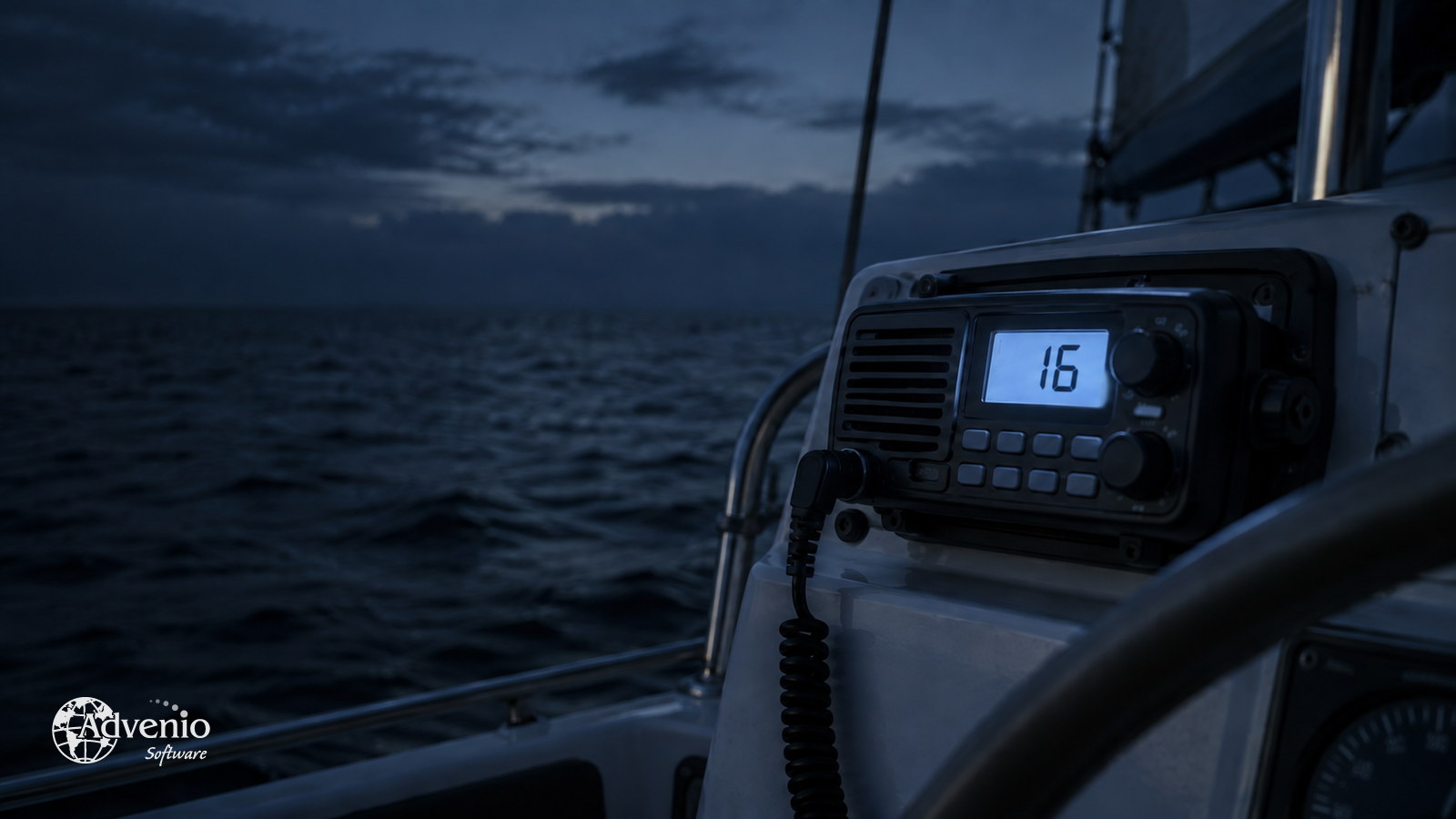
Channel 16 is the first thing taught in a radio communications course. It is also the first thing forgotten the moment a cadet steps aboard.
The mistake is not technical. Nobody confuses the frequency or fails to switch the set on. The mistake is one of judgement: channel 16 is for calling, not for talking.
What channel 16 is
Channel 16 operates on 156.800 MHz and has four assigned functions: distress, urgency, safety and calling.
It is the frequency on which a MAYDAY, a PAN-PAN or a SÉCURITÉ is transmitted, and it is also the frequency on which one vessel calls another to establish contact. That dual function is precisely where the problem starts.
Calling is not conversing
The correct procedure has three steps and takes less than a minute:
- Call the vessel you want to speak to.
- Agree to move to a working channel.
- Leave 16.
That is all. Channel 16 is the hallway, not the meeting room. Once contact is established, the conversation moves to a working channel and the distress frequency is left clear.
What happens in practice is different: contact is established and the conversation simply continues there, because it is already working and changing channels feels like unnecessary paperwork. Five minutes of apparently harmless talk.
Why occupying the frequency has consequences
Channel 16 is a shared resource with simultaneous access. While two vessels are talking, any other vessel attempting to transmit on that frequency is blocked.
That means a distress alert may not get through. Not because the equipment failed, not because the position was wrong: simply because the frequency is occupied by a conversation that should have moved four minutes earlier.
It is a risk that is never visible from the talker’s side. Whoever is blocking the frequency cannot hear the vessel that cannot transmit.
The listening watch
There is a second obligation forgotten just as easily: maintain a listening watch on 16 even when you have nothing to say.
The maritime distress system does not rely on coordination centres alone. It relies on vessels listening. In many coastal areas the vessel nearest an emergency is the one that will arrive first, and it will only know there is an emergency if the set was on and tuned to 16.
Anyone sailing with the VHF switched off, or parked on a working channel for the whole trip, has opted out of the system. They may be the only one who could hear a call for help, and they will not hear it.
How this looks in a simulation exercise
In an exercise the mistake surfaces within minutes, and with a clarity no lecture achieves.
The cadet establishes contact and carries on talking on 16. Meanwhile, in the same scenario, another vessel is trying to transmit a distress alert and cannot get through. The cadet has no idea: they are busy talking.
That is the point at which the exercise stops being about buttons and starts being about what matters. The frequency is a shared resource, occupying it has consequences, and those consequences fall on someone else.
It is the kind of mistake that is not corrected by explaining it. It is corrected by letting the cadet make it where nobody dies, and then showing them in the debriefing the full record of what happened on the frequency while they were talking.
What this means for training providers
The gap between knowing a procedure and applying it under load does not close with one more slide. It closes with repetition in an environment where the mistake has visible consequences and no casualties.
Channel 16 — 156.800 MHz. Distress, urgency, safety and calling. Continuous watch, brief use.
Advenio Software develops maritime safety solutions: GMDSS training simulators, coastal radio station software and nautical training tools, for both the professional and the recreational sector.