
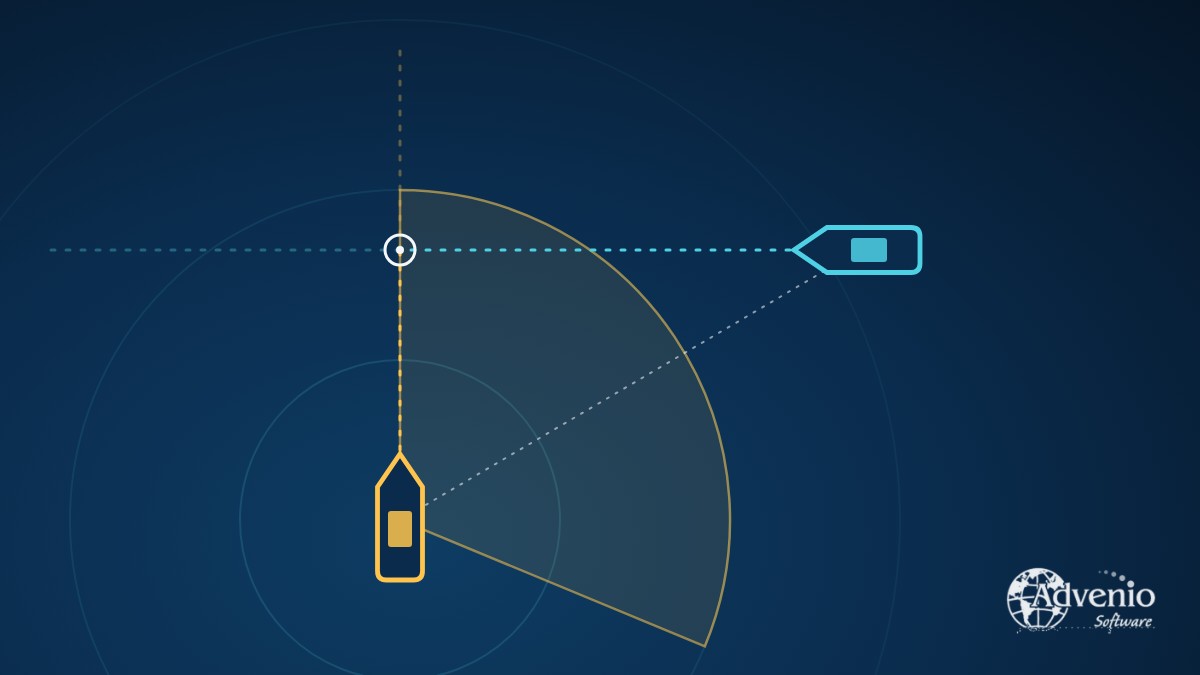
Two vessels are navigating in sight of one another on courses that intersect, and the distance between them is closing. Which one gives way? It is a situation that arises frequently at sea and a classic question in nautical training.
The answer is found in Rules 15, 16 and 17 of the COLREGs (International Regulations for Preventing Collisions at Sea, 1972). This article summarises what they say, how they relate to one another, and the cases in which a different rule decides.
When a crossing situation exists
Rule 15 refers to two power-driven vessels crossing so as to involve risk of collision. Three conditions follow from this:
- The vessels must be in sight of one another. The rules of this section (Section II of Part B, Rules 11 to 18) apply to vessels in sight of one another. For vessels not in sight of one another when navigating in or near an area of restricted visibility, Rule 19 applies (see below).
- Both must be power-driven vessels. Between two sailing vessels, Rule 12 applies; between vessels of different types (for example, a power-driven vessel and a sailing vessel or a vessel engaged in fishing), Rule 18 applies.
- There must be risk of collision. Rule 7 requires every vessel to use all available means appropriate to the prevailing circumstances and conditions to determine whether it exists, and provides that if there is any doubt such risk shall be deemed to exist.
Under Rule 7, risk of collision shall be deemed to exist if the compass bearing of an approaching vessel does not appreciably change. The same rule adds that such risk may sometimes exist even when an appreciable bearing change is evident, particularly when approaching a very large vessel or a tow, or when approaching a vessel at close range. It also states that assumptions shall not be made on the basis of scanty information, especially scanty radar information.
Rule 15: who gives way in a crossing between two power-driven vessels
The text is short: the vessel which has the other on her own starboard side shall keep out of the way and shall, if the circumstances of the case admit, avoid crossing ahead of the other vessel.
In other words, the criterion is relative position: on which side each vessel has the other. The vessel that has the other on her starboard side is the vessel that keeps out of the way (the give-way vessel); the other is the stand-on vessel.
At night, that position is reflected in the lights each vessel sees of the other, but it is advisable to reason from relative position rather than from colour: the light that is seen is a consequence of the geometry of the crossing, not the criterion of the rule. To review which lights are seen from each sector, see the previous article in this series: Navigation lights: which way is a ship heading at night.
Rule 16: the give-way vessel
Rule 16 is a single sentence: every vessel which is directed to keep out of the way of another vessel shall, so far as possible, take early and substantial action to keep well clear.
Rule 8, on action to avoid collision, complements Rule 16. Among other things, it provides that any action taken to avoid collision shall, if the circumstances of the case admit:
- be positive, made in ample time and with due regard to the observance of good seamanship;
- be large enough to be readily apparent to another vessel observing visually or by radar, a succession of small alterations of course and/or speed being avoided;
- result in passing at a safe distance, the effectiveness of the action being carefully checked until the other vessel is finally past and clear.
Rule 8 adds that, if there is sufficient sea room, alteration of course alone may be the most effective action to avoid a close-quarters situation, provided that it is made in good time, is substantial and does not result in another close-quarters situation. It also provides that, if necessary to avoid collision or allow more time to assess the situation, a vessel shall slow down or take all way off by stopping or reversing her means of propulsion.
Rule 17: the stand-on vessel
Where one of two vessels is to keep out of the way, the other, the stand-on vessel, shall keep her course and speed (17.a.i). This obligation is not limited to crossing situations: it applies in any situation in which another vessel is required to keep out of the way.
Rule 17 also provides for two moments at which the stand-on vessel manoeuvres:
- As soon as it becomes apparent to her that the vessel required to keep out of the way is not taking appropriate action in compliance with the Rules, she may take action to avoid collision by her manoeuvre alone (17.a.ii). A power-driven vessel which does so in a crossing situation with another power-driven vessel shall, if the circumstances of the case admit, not alter course to port for a vessel on her own port side (17.c). This restriction is worded for the manoeuvre under subparagraph (a)(ii).
- When, from any cause, she finds herself so close that collision cannot be avoided by the action of the give-way vessel alone, she shall take such action as will best aid to avoid collision (17.b).
Finally, Rule 17.d states that none of this relieves the give-way vessel of her obligation to keep out of the way.
Rule 34.d: the doubt signal
When vessels in sight of one another are approaching each other and from any cause either vessel fails to understand the intentions or actions of the other, or is in doubt whether sufficient action is being taken by the other to avoid collision, Rule 34.d provides that the vessel in doubt shall immediately indicate such doubt by giving at least five short and rapid blasts on the whistle. This signal may be supplemented by a light signal of at least five short and rapid flashes.
It is not a signal exclusive to crossing situations: it applies to any situation between vessels in sight of one another that are approaching each other. It indicates doubt; it does not indicate any manoeuvre.
Other situations: when a different rule decides
Rule 15 applies only to a crossing between two power-driven vessels. In other situations, which vessel gives way is determined by other rules, and Rules 16 and 17 apply equally to the give-way vessel and the stand-on vessel. The following should be kept in mind:
- Overtaking (Rule 13): any vessel overtaking any other shall keep out of the way of the vessel being overtaken. A vessel is deemed to be overtaking when coming up with another vessel from a direction more than 22.5 degrees abaft her beam. Any subsequent alteration of the bearing between the two vessels shall not make the overtaking vessel a crossing vessel, or relieve her of the duty of keeping clear of the overtaken vessel until she is finally past and clear. When a vessel is in any doubt as to whether she is overtaking another, she shall assume that this is the case and act accordingly.
- Meeting head-on (Rule 14): when two power-driven vessels are meeting on reciprocal or nearly reciprocal courses so as to involve risk of collision, each shall alter her course to starboard so that each shall pass on the port side of the other. Such a situation is deemed to exist when a vessel sees the other ahead or nearly ahead. When a vessel is in any doubt as to whether such a situation exists, she shall assume that it does exist and act accordingly.
- Different categories of vessel (Rule 18): except where Rules 9, 10 and 13 otherwise require, a power-driven vessel underway shall keep out of the way of a vessel not under command, a vessel restricted in her ability to manoeuvre, a vessel engaged in fishing and a sailing vessel. A sailing vessel underway shall keep out of the way of the first three of these, and a vessel engaged in fishing when underway shall, so far as possible, keep out of the way of the first two. Rule 18 also contains provisions on vessels constrained by their draught, seaplanes and wing-in-ground (WIG) craft.
- Vessels not in sight of one another (Rule 19): Rule 19 applies to vessels not in sight of one another when navigating in or near an area of restricted visibility. A vessel which detects by radar alone the presence of another vessel shall determine if a close-quarters situation is developing and/or risk of collision exists. If so, she shall take avoiding action in ample time, provided that when such action consists of an alteration of course, so far as possible the following shall be avoided: an alteration of course to port for a vessel forward of the beam, other than for a vessel being overtaken; and an alteration of course towards a vessel abeam or abaft the beam.
In addition, Rule 2 provides that nothing in the Rules shall exonerate any vessel, or the owner, master or crew thereof, from the consequences of any neglect to comply with the Rules or of the neglect of any precaution which may be required by the ordinary practice of seamen, or by the special circumstances of the case. It also provides that in construing and complying with the Rules due regard shall be had to all dangers of navigation and collision and to any special circumstances, including the limitations of the vessels involved, which may make a departure from the Rules necessary to avoid immediate danger.
Practising light recognition
Resolving a crossing at night begins with correctly interpreting what is seen: which lights they are, from which sector they are observed, and what type of vessel and activity they indicate. To practise this, Advenio developed ColRegs: Nav Lights Quiz, a question-based app for learning the navigation lights of the Regulations, available on Google Play and the App Store.
A final note
This article is an orientation guide, not a legal text. It summarises the COLREGs as they appear in the international text, but it does not replace the full Regulations, the rules of each country or the judgement of the master. The rules apply together, and the specific situation of each vessel may require other provisions to be considered.
Sources: IMO, Convention on the International Regulations for Preventing Collisions at Sea, 1972 (COLREG), Rules 2, 7, 8, 11 to 19 and 34.