
Navigation lights are first learned as a catalogue, and rightly so: until you know what the vessel is, there is nothing to read. Green over white, all-round: a vessel engaged in trawling. Two all-round red lights in a vertical line: a vessel not under command.
But the catalogue answers only one question. At night there is another, just as urgent: where is she heading, and whose job is it to keep out of the way? Part of that answer is also in the lights. The rest is not, and confusing the two is the trap.
Four lights, four sectors
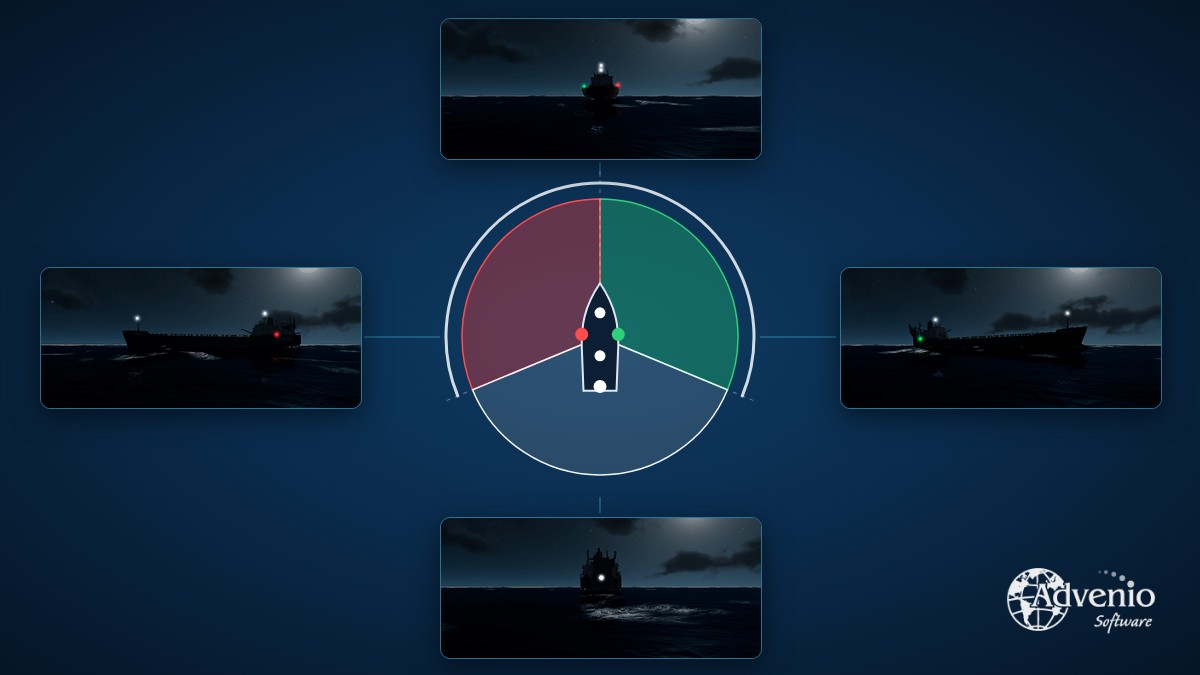
In her standard configuration, a power-driven vessel underway shows:
- A masthead light, white, over the fore-and-aft centreline: 225°, from right ahead to 22.5° abaft the beam on either side. Vessels of 50 metres or more show two: one forward and a second one further aft and higher.
- Sidelights, green to starboard and red to port: 112.5° each, from right ahead to 22.5° abaft the beam on its own side.
- A sternlight, white, as nearly as practicable at the stern: 135°.
Vessels of less than 12 metres have some alternative arrangements provided for in Rule 23.
The sidelights and the sternlight share the horizon between them, so what you see tells you which of the other vessel’s sectors you are in. With two qualifications. At the edges of each sector the reading can be ambiguous. And the lights do not all have the same range, so at a great distance a single white masthead light may be the first thing you see: on a vessel of 50 metres or more it must be visible at six miles, while the sidelights must be visible at three. That applies, of course, when you are within the 225° sector covered by her masthead light.
What you see, and what it means
Red and green together. You are seeing her from ahead or nearly ahead. It is the typical aspect of a head-on situation, but the lights alone do not tell you that risk of collision exists: you still have to watch her bearing and the relative movement.
Green only. You are in her starboard sector.
Red only. You are in her port sector.
Sternlight only. You are astern of her, more than 22.5° abaft her beam. If the range is closing, you are the overtaking vessel and it is you who keeps out of the way, whatever the type of vessel: a sailing vessel overtaking a merchant ship keeps out of the way too.
A word of caution on that last one: a lone white light is not always a sternlight. It may also be the masthead light of a vessel approaching or crossing whose sidelights cannot yet be made out; a vessel of less than 50 metres at anchor; or a small craft. Do not take it for a vessel moving away without checking that the range is not closing.
What the lights don’t tell you
So far, the lights have told you how the other vessel is pointing in relation to you. To know who has to manoeuvre, two facts are missing, and neither is on the other vessel:
On which side of your own vessel she is. A red light on your starboard side is not the same as a red light on your port side.
Whether her compass bearing changes. If the compass bearing of an approaching vessel does not appreciably change, risk of collision is deemed to exist. And it may exist even when the bearing does change, particularly with a very large vessel, a tow, or at close range.
With those two facts, between two power-driven vessels in sight of one another:
- Red and green, ahead of you, on reciprocal or nearly reciprocal courses and with risk of collision: a head-on situation. Both alter course to starboard. If she is not ahead of you, on the other hand, it is a crossing situation.
- In the typical crossing, red on your starboard side, with risk of collision: you have the other vessel on your own starboard side, and it is you who keeps out of the way, early and substantially, avoiding crossing ahead of her if the circumstances allow. As the old rhyme has it: if to your starboard red appear, it is your duty to keep clear. If the red light is clearly on your quarter, more than 22.5° abaft your own beam, it is she who is overtaking and she who keeps out of the way; close to that limit, better not to take it for granted.
- In the typical crossing, green on your port side, with risk of collision: she has you on her starboard side, and it is she who must keep out of the way. You keep your course and speed, without switching off: if you are in doubt whether she is taking sufficient action, you must indicate your doubt by giving at least five short and rapid blasts; if it becomes apparent that she is not taking appropriate action, the rules allow you to manoeuvre on your own, as far as possible without altering to port towards her; and they oblige you to when collision can no longer be avoided by her action alone.
- Red on your port side or green on your starboard side: this usually means the vessels will pass clear without crossing ahead of each other. But do not decide on colour alone: if she is ahead or nearly ahead, the bearing is not opening and her aspect leaves you in doubt whether the courses are reciprocal or nearly so, the rules require you to assume it is a head-on situation and act accordingly: to starboard, early and clearly, never to port.
What decides in every case is relative position, not colour. Red and green are how you see it at night; learning “red, give way; green, stand on” as a stand-alone rule leads to mistakes.
Three cautions
First what she is, then where from. This logic applies between two power-driven vessels. With a sailing vessel, a vessel engaged in fishing, one not under command or one restricted in her ability to manoeuvre—and also in special situations, such as a vessel constrained by her draught—responsibilities may change under Rule 18. Rules 9, 10 and 13 also introduce important exceptions; above all Rule 13: the overtaking vessel always keeps out of the way. And beware of a much-repeated clue: sidelights without a masthead light mean she is not a power-driven vessel underway. She may be a sailing vessel, but she may also be a vessel being towed, and getting that wrong means looking for a way through between the towing vessel and her tow.
All of this applies to vessels in sight of one another. When vessels are not in sight of one another and are navigating in or near an area of restricted visibility, Rule 19 applies. If the other vessel is detected by radar alone, the crossing, head-on and stand-on rules we have just described do not apply: Rule 19 has its own logic for assessing and avoiding a close-quarters situation.
When in doubt, the rules have already decided. If there is any doubt whether risk of collision exists, it is deemed to exist. If there is doubt whether you are overtaking another vessel, you are. If there is doubt whether it is a head-on situation, it is.
What this means for trainers
On the flashcard, the same vessel seen from ahead, from starboard and from port has the same answer. On the water they are different situations, and what decides is not only which lights you see, but on which side of your own vessel they are and what the bearing is doing. The question that prepares you for the night is not only “what vessel is that?” but “what do I do?”.
That is why it pays off so well to work with the same vessel seen from all four aspects and to move from recognising to deciding: it is what prepares you for the moment when, at three in the morning, a red light appears on your starboard side and the bearing does not move.
Advenio Software develops maritime safety solutions: GMDSS simulators, coast station software and nautical training tools, for both the professional sector and leisure boating.