
In training courses, “man overboard” is a manoeuvre. It gets drawn on the board, each variant has its own name, and the student is assessed on knowing which one fits each case.
The manoeuvre matters. But it is not the first thing, and getting that order wrong is what turns a rescue into a search.
It also helps to know the size of the problem. The UK’s MAIB reviewed 308 man overboard occurrences between 2015 and 2023: 40 % ended in a fatality, and on pleasure craft, 47 %. Almost one in two.
The first minute
Shout. “Man overboard!”, and which side. This is not drama: it is the only way the rest of the crew drops what they are doing.
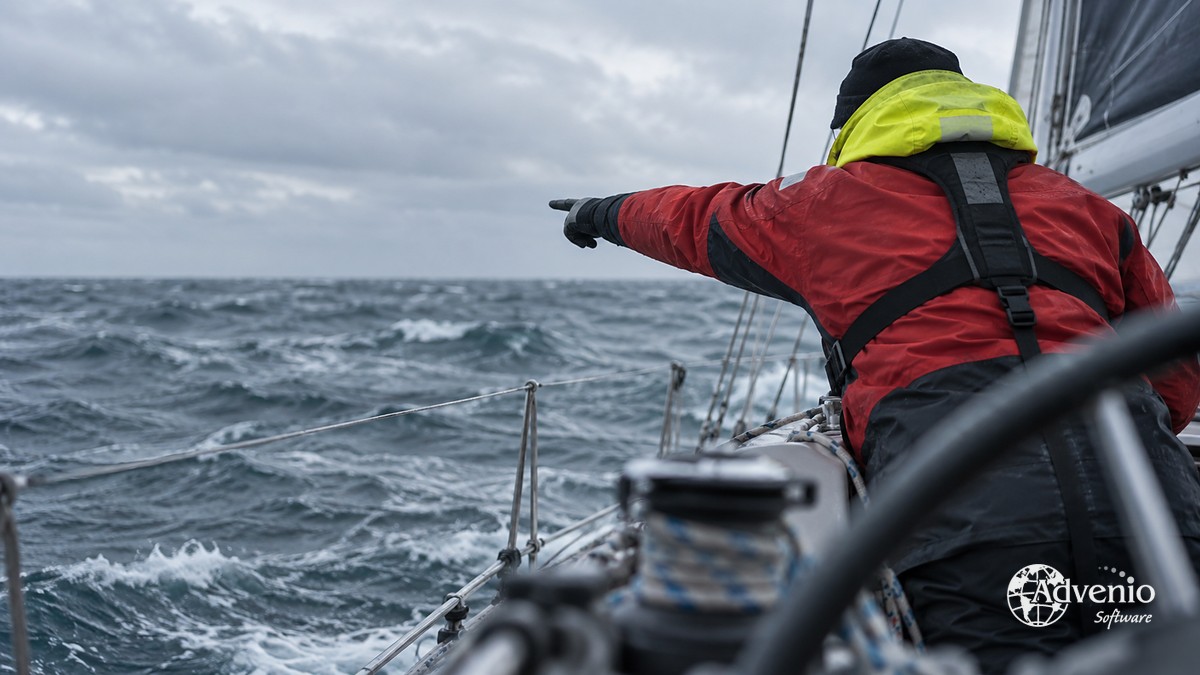
Someone points and never stops looking. One person, designated, arm extended towards the casualty, doing nothing else. Not trimming a sheet, not fetching the lifering, not looking at the plotter. Just looking and pointing.
Throw buoyancy, now. The lifering, a fender, a lifejacket, whatever is to hand. Even if it seems to land far away it is worth it: besides giving them something to hold if it reaches them, it leaves a mark on the water, and a floating object is far easier to see than a head.
Press the MOB key on the GPS or plotter, which records the coordinates and the time of that instant and leaves a point to return to.
Raise the alert. On channel 16, or the distress button if the situation warrants it. And here it is worth being clear: the alert is for others to come and help, not to solve the problem. Whoever can solve it is aboard.
That is the RYA’s order and World Sailing’s. It is not unanimous — US Sailing puts buoyancy before designating the spotter — but none of them dispute that all five things happen within the first minute.
Why the spotter comes first
Because a head in the water is almost invisible.
With a rippled sea — thirty centimetres of wave, nothing — a head appears and disappears between the crests. And whoever is looking does so from the cockpit, barely a metre above the water, not from a helicopter. Add backlight, or the distance the boat has already run, and it stops being visible.
Now the part that is almost never explained: while somebody can see them, this is a rescue. The second they are lost from sight, a search begins. And the two are nothing alike.
A rescue is returning to a point. A search is sweeping an area that keeps growing, because the casualty is moved by the current, the wind and the swell, each in its own direction. The point recorded by the MOB key is where the boat was, not where the person is, and the gap between the two grows with every minute.
That is why the spotter is the first task and not a secondary one: it is the only thing that stops the problem changing category.
And if there are two of you aboard
Then there is no spotter, and that is worth saying. With a couple sailing — which is half the cruising fleet — whoever stays aboard has to steer, look, communicate and lift, and cannot do all four.
The Cruising Club of America puts it plainly for short-handed crews: if there is nobody to designate, the priority becomes not getting separated. Buoyancy in the water straight away and within reach of the helm, no sailing off to make a tidy manoeuvre, and a system that works one-handed — the towed Lifesling-type sling, circling the person until it reaches them. It is the most common scenario in leisure sailing and the least practised.
The manoeuvre is second
Which one applies depends on the boat, the wind and whether the casualty is still in sight. Under sail, the answer is usually to come back at once without sailing away. In a powerboat, current teaching has moved away from turning immediately towards them: a sharp turn at speed brings the stern and the propeller closer to them, and can put someone else in the water. You reduce speed in a straight line and come back under control. (On a large ship the doctrine does begin by turning towards the side they fell; but that is a different vessel and a different problem.)
Two things hold for all of them. The first is that you arrive with very little way on. The second is that the propeller is stopped before you have them close: it is the rule most often forgotten in the adrenaline, and the one that can cause the most serious injuries in the whole procedure. The RYA says it without qualification — engines in neutral or switched off, the risk to the casualty from a spinning propeller must be avoided at all costs.
What is not a rule, although plenty of courses teach it as if it were, is which side the casualty ends up on. There are two schools:
The casualty to leeward, with the boat upwind. This is what the RYA teaches: as the boat loses way the wind carries it towards them rather than away, and the hull shelters them from the sea. The risk is the obvious one: if the boat drifts fast — high freeboard, shallow draught, a made-up sea — it goes over them.
The casualty to windward, with the boat downwind. This is the quick stop recovery as documented by World Sailing and US Sailing. It removes the risk of drifting over them, at the cost of the boat drifting away: you have to get hold of them fast and not let go.
The United States Coast Guard lists both with that same trade-off and decides for neither: leeward shelters from the sea, but there is a danger of the vessel being blown over the casualty; windward reduces that danger.
What tips the balance is how fast your own boat drifts, and that is in no manual: you learn it by having tried it with that boat.
What almost nobody practises
And here is the second uncomfortable fact: the hard part is not reaching them. It is lifting them.
A soaked person weighs far more than they do on the pontoon, may have no grip left in their hands from the cold or be unconscious outright, and the freeboard of a cruising yacht, seen from the water, is a wall.
From the same cases comes the clock: the MAIB calculates under eleven minutes to recover someone who has fallen into cold water before they stop responding, and less if the water is colder or the sea rougher. Its recommendation is to run drills actually using the equipment you intend to lift them with, not explaining it.
The standard method is a halyard to the harness or lifejacket, ground in on the winch, with a purchase to reduce the load if needed. The RYA also lists a block and tackle from the boom, a dedicated lifting device or a davit, and, for anyone who can climb aboard under their own power, a net or a ladder.
Two warnings worth keeping:
The bathing ladder is not a plan. It works in flat water with someone who still has strength. In a made-up sea it is useless and dangerous: the transom rises and falls over the person.
A hypothermic casualty is lifted horizontally, not hanging vertically, provided that does not mean taking longer: the United States Coast Guard and World Sailing both say so, because lifting a badly chilled person vertically can trigger circulatory collapse.
And one warning all the sources agree on: going into the water is the last resort, not the first, and whoever does it wears a lifejacket or immersion suit and is tethered to the boat by a line. Otherwise the risk is ending up with two people in the water and none aboard.
The cold does not wait until you are ready
The water does not have to be freezing. Below 15 °C — which is half the Mediterranean in winter and much of the Atlantic almost all year — the cold shock response appears: uncontrollable gasping in the first thirty seconds, which can fill the lungs with water or trigger a cardiac event. It is believed to be responsible for most sudden immersion deaths, with the person still afloat and conscious.
After that, physical capacity is lost progressively. The hands stop closing before the person feels they are in trouble, and that is exactly what prevents gripping a line or holding a sling.
On timings it pays to be careful. The “1-10-1” rule is widely repeated — one minute to control your breathing, ten of meaningful movement, one hour before losing consciousness — and is taught among others by the Canadian Safe Boating Council; the National Center for Cold Water Safety disputes it, arguing that it contradicts what the researcher who originated it actually published, and that capacity is not lost all at once at minute ten but from the start. With that argument open, better to give no timings at all: every minute of delay does not subtract a minute, it subtracts the ability to help in one’s own rescue.
And the one thing the person in the water can do, which is almost never taught: do not swim straight away. The RNLI insists on “float to live” — lie back and float until the first cold shock passes, and only then decide. Swimming while gasping is the fastest way to swallow water.
What each device actually does
They tend to get lumped together and they do different things. It is worth separating them — without getting into what to buy, which depends on where and how you sail:
The MOB key on the plotter marks a point on the chart with its time. It alerts nobody. It is memory, not communication.
The personal AIS beacon appears as a target on the plotters of AIS-equipped boats nearby: it is what gets your own boat to find you. One recent detail that has not yet reached the courses: in Europe new units must be Class M, which also transmit DSC on channel 70 and set off an audible alarm on nearby VHF sets — precisely because a silent icon on a screen gets missed. The older AIS-only beacons still work, but they are being withdrawn.
The personal locator beacon (PLB) transmits by satellite to the Cospas-Sarsat system and the alert reaches a rescue coordination centre: worldwide coverage, without depending on boats being nearby, at the cost of the circuit taking its time.
Both are fitted inside the lifejacket, both have to be registered, and there are units that combine the two.
The VHF distress alert warns the coast station and every vessel in range, with the position of the boat. Which is not the casualty’s position, and stops being it very quickly.
They are not alternatives and do not replace one another: they cover different gaps — who finds you, who searches for you, and with how much delay. Which one makes sense to carry depends on the area, the kind of sailing and what the boats around you carry.
What this means for trainers
Man overboard shares a difficulty with the distress procedure: the half that decides the outcome is precisely the half that cannot be practised. Nobody is going to throw a person into the water for the crew to lift out, and on a weekend course the time afloat is what it is.
So the manoeuvre is taught and assessed, because it is what the format allows. The spotter who never drops their eyes, the division of tasks when there are two people aboard and both are busy, and the moment of lifting seventy soaked kilos over a metre of freeboard get described, but not lived. That is not a problem with whoever teaches the class: it is a problem of what can be set up.
That is where simulation gives what the classroom cannot: dividing tasks with the clock running, forcing someone to say out loud who is looking, who is communicating and who is rigging the lift, repeating it until it comes without thinking, and afterwards showing what happened in each second — which is the part that turns the exercise into a lesson.
Which is the only way that, on the day it happens, somebody points with their arm and does not look away.
Advenio Software develops maritime safety solutions: GMDSS simulators, coast station software and nautical training tools, for both the professional sector and leisure boating.